NEPTUNE Canada

print page

Earthquakes and plate tectonics

Subduction zones like the one along the eastern edge of the Juan de Fuca plate generate some of the world's largest earthquakes, often associated with devastating tsunamis. NEPTUNE Canada's array of sensitive instruments will augment other land-based seismic networks in Canada and the U.S., helping researchers better understand subduction processes and improve their estimates of seismic risk.

Cross-section showing the Juan de Fuca plate with axial expansion on the western edge and subduction on the eastern edge.

Along the western edge of the Juan de Fuca plate, new seafloor is created through plate boundary spreading and volcanic activity. NEPTUNE Canada will install seismometers on the Endeavour segment of the Juan de Fuca Ridge to help pinpoint the many earthquakes that shake that region every year. Closely related phenomena like hot fluid venting and volcanic eruptions will also be studied in conjunction.

In addition, NEPTUNE Canada will install an extensive array of high-precision bottom pressure sensors, which can detect tsunamis from local or distant sources. This array will help researchers refine their understanding of how tsunamis move through both deep ocean and coastal areas.

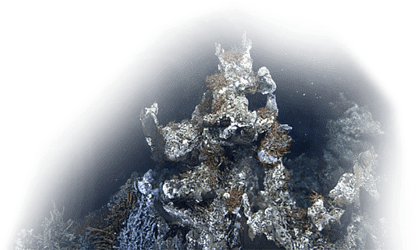
Hot vent

Hot fluids vent from the seafloor along Endeavour Ridge.

Hot fluids vent from the seafloor in volcanically active Endeavour Ridge. Photo taken from ROPOS by Verena Tunnicliffe and Kim Juniper, 21 August 2002.

Cascadia tsunami

As tsunamis can move rapidly through the open ocean, a large earthquake off British Columbia could send a tsunami crashing into coastal regions in as little as 10-15 minutes.

This computer simulation shows the main wave of the Cascadia tsunami as it crossed the mid-Pacific on 26 January 1700.  Severe damage occurred both in coastal First Nations communities in British Columbia and Japan. A similar earthquake is expected sometime in the next 200 years. 

Computer simulation of the Cascadia tsunami of January 1700.

NEPTUNE Canada will install highly sensitive bottom pressure recorders to aid in tsunami detection and tracking. While not specifically designed as a tsunami warning system, this sensor array will contribute substantially to our understanding of tsunamis in the northeast Pacific.

Learn more about tsunamis in this short presentation by NEPTUNE Canada scientist Brian Bornhold.

Copyright © 2010 NEPTUNE Canada
P.O. Box 1700 STN CSC, Victoria BC, Canada, V8W 2Y2
1 250 472 5400 | Contact Us
NEPTUNE Canada is a project of